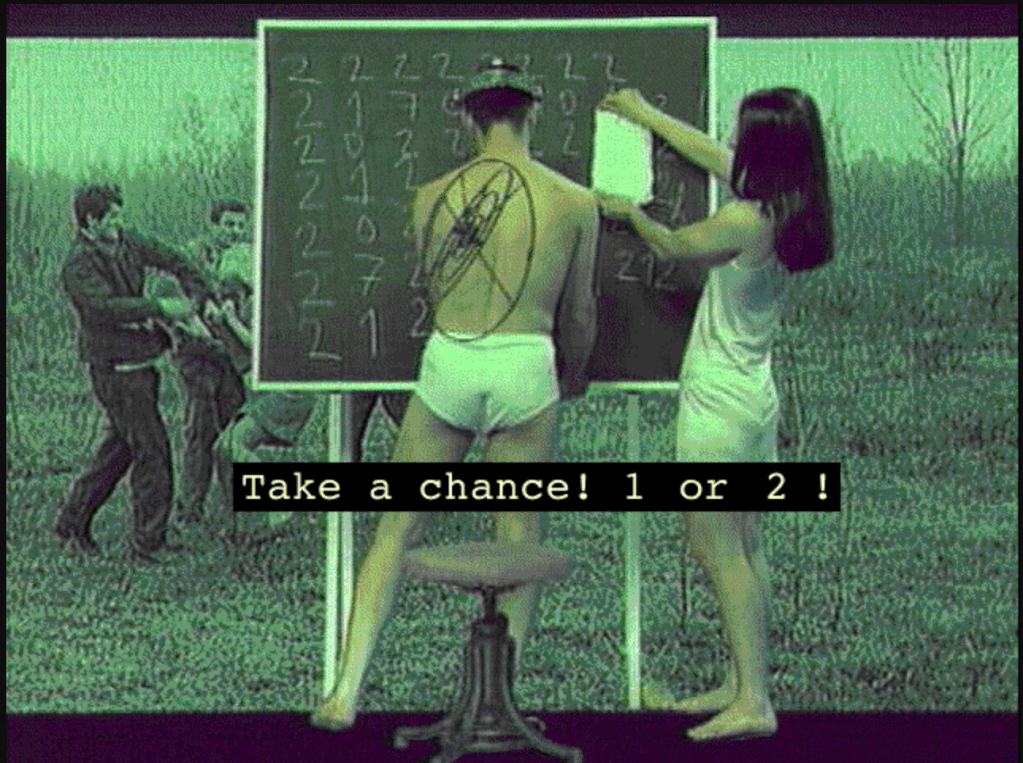
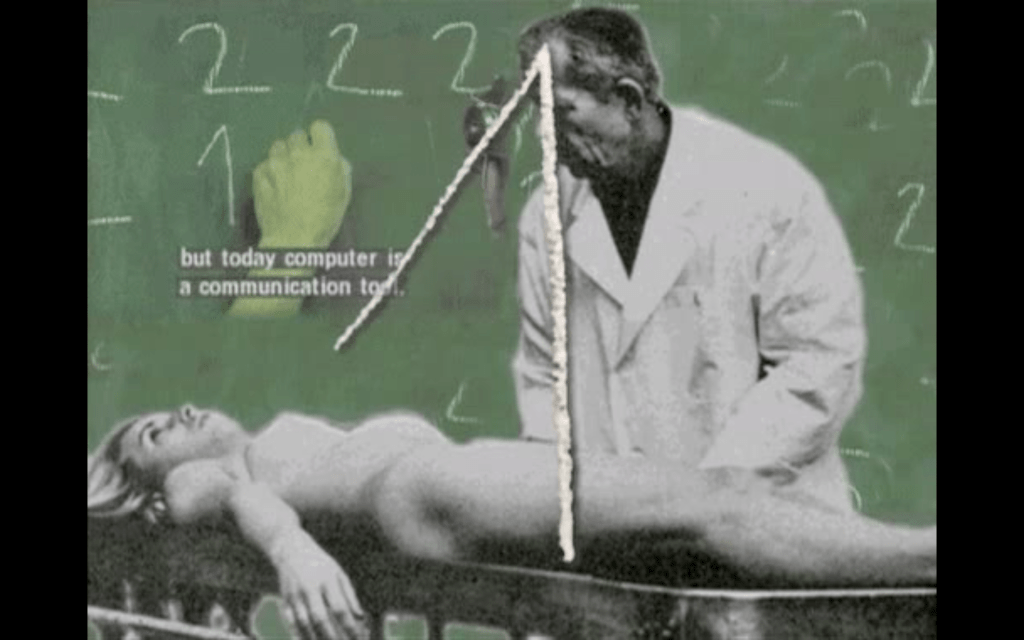
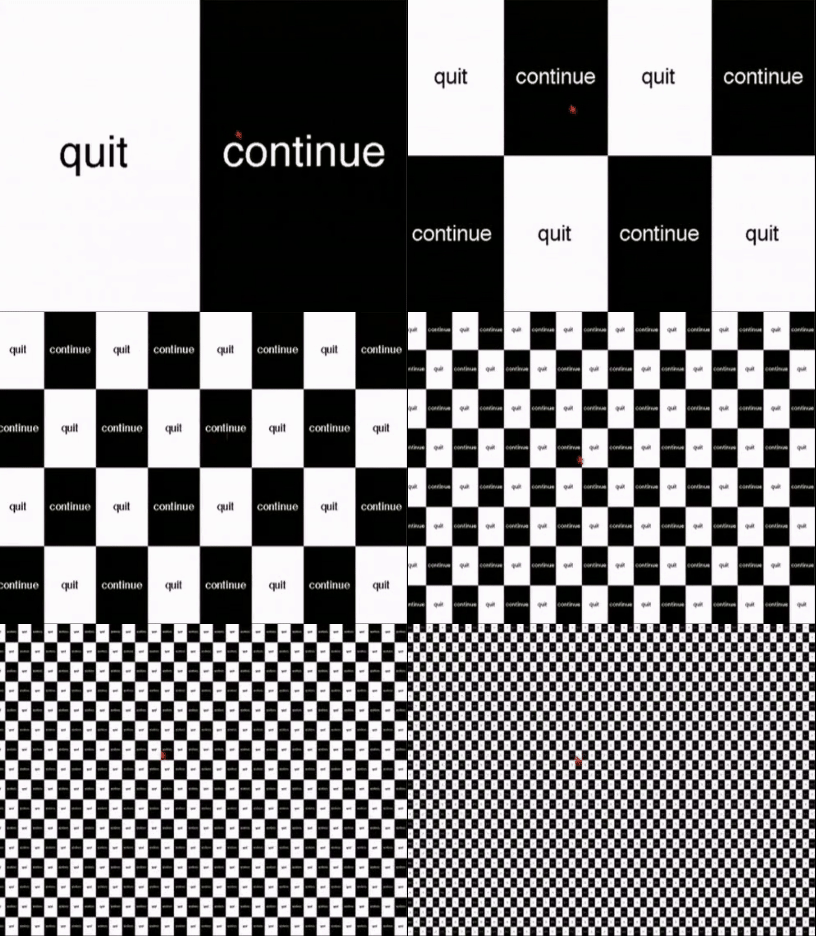
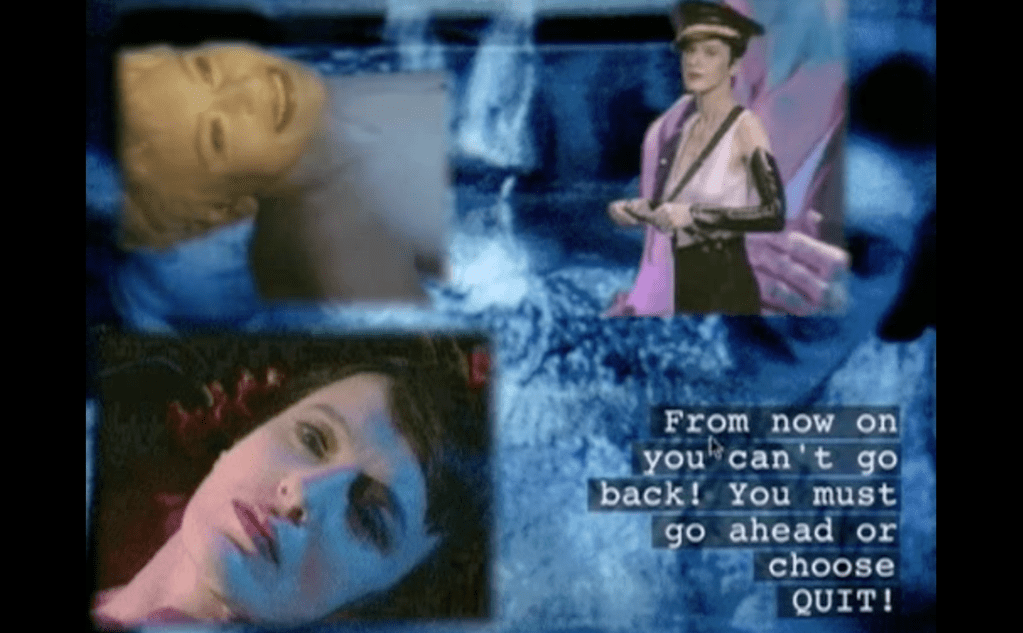
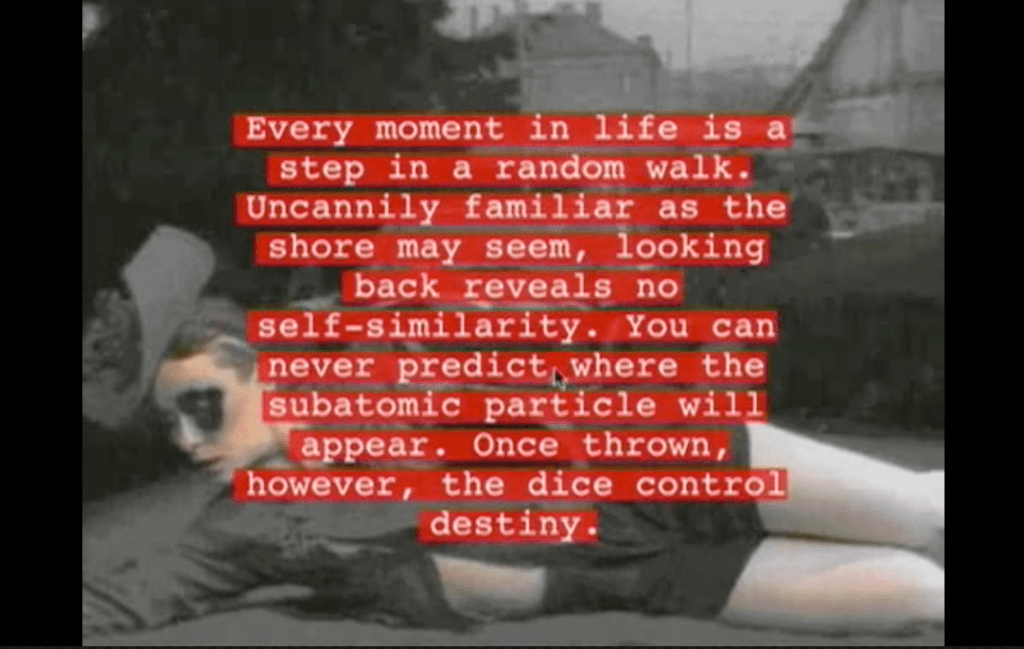
“The work consists from the video, film and theoretical work by Grzinic & Smid (in the period between 1982 and 1997), and now classified on four levels of values ranging from – – to -+, and from +- to ++. It starts with pure chance or contingency (the user is the agency which chooses between the numbers 1 or 2). The user is a gambler. The numbers 1 or 2 are connectors that link up with different images, texts and interactions in the work. The images and interactions express function and redundancy on the one hand, and meaning, nonsense, chance, destiny and void on the other hand. It is not possible to travel through the four structures without changing them in accordance with our particular history, intimacy, prejudices and stereotypes. The user in order to proceed has to answer to questions, which are attacking his or her values, moral horizons and political affiliations. Unlike most CD-ROM structures, after choosing between 1 and 2 the user cannot change the path of events by leaping backwards and forwards. The user either proceeds up to the end, or else has to quit.”
“Slovenian artists Marina Gržinić and Aina Šmid’s CD-ROM Troubles with Sex, Theory & History (1997, in collaboration with Steffen Ruyl Cramer) provides a critical perspective on the relationship between gender, sexuality, and interactivity from the Balkans, a rarely seen post-communist perspective, and further explores the potential of interactive technologies as new historiographical tools with the power to subvert various levels of master narratives (historical, cultural, sexual, gender- and class-oriented, etc.). When discussing interactive case studies outside of the range of “Western” media–for instance, when referring to the more marginalized East/Center/Southern countries within the West–we must be cautious not to essentialize these practices as merely derivative of their region, culture, artists’ gender and other reductive categorizations. Thanks to their digitality and virtual presence, most these practices transcend many of the aforementioned specificities, as previously discussed in other chapters. Nevertheless, in mentioning some marginalized examples from, in this case, the former “East” and the Balkans of the West, my objective is to engage in cross-cultural comparative media analysis to provide more cultural layers to digital studies and also to add sociopolitical urgency to the study of interactivity. The nuanced discussion of Troubles in the bookis meant to further diversify the scope of interactive art practices by including artists from underrepresented spaces within Western discourse…
Keep in mind that my interactive encounter with Troubles was through doubly and triply remediated forms. I initially interacted with a DVD-ROM converted version of the original CD-ROM that was part of a collection of interactive art projects titled Artintact: Artist’s Interactive CD-ROMagazine, produced by the Zentrum fur Kunst und Medientechnologie (or ZKM/ Center for Arts and Media Technology). The CD-ROM magazine was published as a series between 1994–99 and then re-released as a complete CD-ROM anthology, followed by a DVD-ROM in 2002. My interaction with the Artintact DVD-ROM was via older hardware and later with a digitized emulator version created for easier access. The multiple attempts to preserve and emulate Troubles in different formats is a continuation ofthe work’s various iterations at site-specific exhibitions and web-based contexts during the period in which it was initially conceived (the late 1990s–early 2000s)…”

 Interactive Media Exhibition